 Designs
 Elements
 Builders
 Home Buyers
 Technology
 About Us
 Blog
Blog

Panelized Homes vs Modular Prefab Homes: What’s the Difference?
Both can help you avoid traditional construction purgatory. Both are constructed — at least partially — in a factory. And both get thrown under the prefabricated home umbrella in a way that makes them seem almost exactly alike.
Spoiler alert: They’re not.
Panelized homes and modular homes work differently, cost differently, and perform differently over their lifespans.
If you’re a homeowner weighing one against the other or just trying to wrap your head around what you’re actually buying — here’s the no-spin comparison.
Panelized vs modular: quick comparison
| Aspect | Panelized | Modular | Traditional |
|---|---|---|---|
| Build time | 6–12 weeks kit; ~3 weeks to lockup on site | 3–6 weeks factory; crane day + finishing | 7–12 months |
| Design flexibility | High, not limited by transport dimensions | Moderate, constrained by module/road specs | High |
| Framing material | Cold-formed steel (Momo) or wood (others) | Typically wood | Typically wood |
| Foundation | Concrete-free helical pile (Momo) or slab | Concrete piers or slab | Concrete slab |
| Transport | Flat panels on standard trucks | Oversized loads; cranes; road escorts required | N/A, built on site |
| HOA treatment | Treated as standard residential construction | Sometimes faces classification resistance | Standard |
| Financing | Standard mortgage pathways (Fannie Mae–eligible) | Some lenders treat as non-standard | Standard |
| Long-term value | High, durable materials, low maintenance | Moderate | Varies |
What is a panelized home?
A panelized house is constructed from sections (wall panels, floor system, roof trusses) built at a factory and delivered flat to your build site, where they’re put up and assembled.
You can think of it like a precision-engineered kit: sections are built in the factory on your timeline, then delivered to your property where they’re assembled by a local crew.
The key term here is precision. Factory manufacturing means that panels are measured, cut and assembled to perfect specs before they arrive onsite.
In Momo’s case, that’s accurate to within a millimeter per 12 feet of wall. Try getting that kind of accuracy when you’re framing walls in the rain.
Interior finishing occurs on site, which is important than it sounds. Local building officials will be able to inspect your house throughout the building process (and not just once it’s finished), coordinating with local building codes will be a breeze.
It also means your house can be adjusted in real time if your construction site throws a curveball (they always throw curveballs).
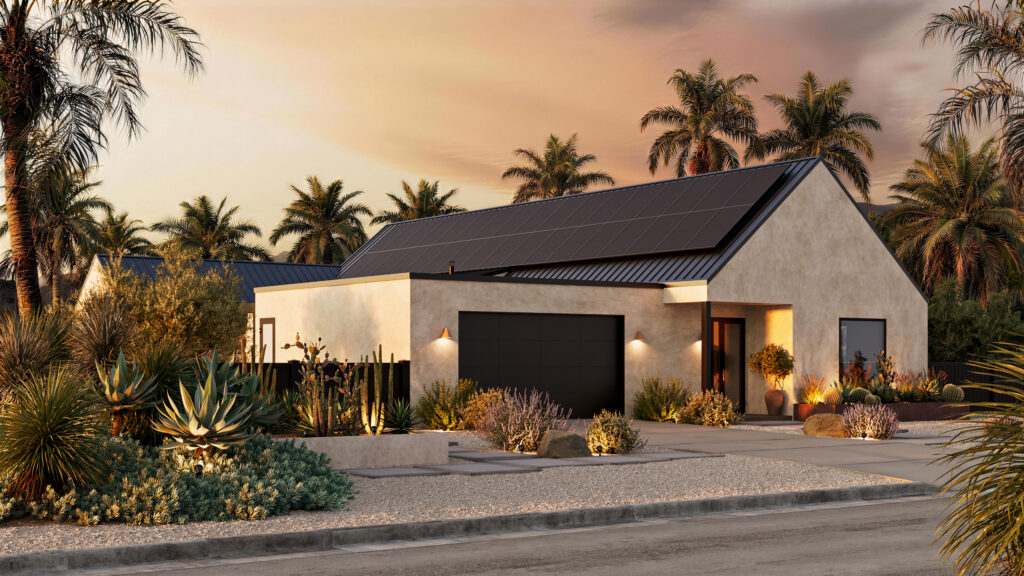

Factory-perfect homes. Delivered to your site.
Momo’s panelized steel system is faster than traditional construction, more flexible than modular, and built to last well over a century. Let’s talk about your project.
What is a modular home?
A modular house is built differently. Instead of shipping flat components, modular construction involves a factory building fully assembled room-sized boxes, complete with walls, flooring, and sometimes interior finishes, that get trucked to your construction site and craned onto a foundation.
The factory work is real and the quality can be solid. But modular homes live and die by logistics. We’re talking oversized loads that require road escorts, crane access on your property, and route planning that can get complicated fast.
Fine Homebuilding documented a real-world modular delivery where a module was too tall for the homeowner’s driveway and required an empty lot half a mile away just to reload.
That’s not a horror story, it’s just the reality of moving room-sized boxes down public roads.
Construction speed: fast vs. faster (but context matters)
Modular is faster for the factory portion. A modular home’s boxes can be built in as little as three to six weeks. Panelized construction runs six to twelve weeks from kit production to on-site assembly.
Honest enough. But that’s not the whole picture.
Site prep, foundation work, permitting, and interior finishing happen no matter which method you choose. When you add those up, total construction time converges more than the factory-build comparison suggests.
A panelized steel home can reach a sealed, locked-up shell in about three weeks on site, faster than the four to six months most generic sources throw around for “prefab.”
There’s also something to be said for the extra on-site time that panelized construction involves. It creates more opportunities for inspections, adjustments, and quality checks.
Speed is great. Speed with quality is better.
Design and customization: where panelized wins
This one isn’t close.
Modular homes are constrained by what can be built in a factory box and driven down a highway.
Module dimensions are set by road transport limits. Floor plans are drawn from a factory catalog. Modifications after specs are locked tend to be expensive or impossible.
Panelized homes aren’t limited by any of that. Panels ship flat on standard trucks, which means designs can be as varied as the architect wants them to be.
Got a narrow lot? Mountain property with a tricky access road? A modular truck probably can’t get there. A flatbed with panels usually can.
The design range speaks for itself. A panelized system can produce a compact 393 sq ft ADU studio and a 3,671 sq ft two-story family home using the same core construction approach. That’s flexibility modular has a hard time to match.
Steel vs. wood framing: the overlooked variable
When people compare panelized vs modular, they treat both as interchangeable categories. But the framing material is its own decision, and it matters quite a lot for how your home performs over decades.
The majority of panelized homes and modular homes are built using wood framing.
Wood makes sense. It’s the most common building material known to man. It’s easy to work with and relatively inexpensive when considering material costs.
Beware, however: wood wraps and decays. Termites like to eat it. It’s flammable. And it must be maintained to prevent moisture intrusion and structural failures.
Cold-formed steel framing is a different category entirely.
| Feature | Steel Framing | Wood Framing |
|---|---|---|
| Lifespan | 50–100+ years | 40–60 years |
| Fire resistance | Non-combustible | Burns |
| Pest resistance | Termite-proof | Vulnerable |
| Rot/warp | None | Susceptible |
| Weight | ~25% lighter | Heavier |
| Maintenance | Very low | Medium to high |
Steel doesn’t warp, melt, split or crack. It won’t give termites a foothold. Moisture and mold is way less of a concern with steel framing behind the drywall.
Unlike wood, cold-formed steel panels allow for extremely precise manufacturing, something you just can’t match with on-site wood framing. Which means tighter seals, better insulation performance, and more predictable structural integrity.
When comparing panelized homes, ask your builders what they’re building with. Construction method and material are two different variables. Material matters when it comes to the performance of your home for the next hundred years.
Foundation options
Most modular and panelized homes end up on concrete piers or a slab. It works. Everyone is familiar with them. It’s also… kind of a carbon-heavy habit.
Concrete’s got high embodied carbon, it needs cure time, and in places with floods or cranky soil, it can be a long-term “hope this stays put” situation.
If you want a cleaner, faster foundation, steel helical piles are hard to beat. Momo’s Surefoot system skips concrete entirely, doesn’t need curing, and it’s engineered for uplift, shear, and moment loads. The crew can usually knock it out in an afternoon.
And yeah, it sounds like a nerdy detail until you realize concrete footings are basically the default because they’ve always been the default. There’s no law of physics that says your house has to start with a giant pour.
Cost, financing, and long-term value
Here’s the rough math (it varies by market, but this is the ballpark):
- Modular: ~$50–$100/sq ft base, ~$80–$160/sq ft finished
- Panelized (shell): starts around ~$110/sq ft
- Traditional (2025): ~$150–$300+/sq ft
So yes, modular can be cheaper upfront on a straightforward build.
But the price tag isn’t the whole story. Steel framing usually means fewer long-term headaches (less rot, fewer pests, fewer “why is this cracking?” surprises). Pair that with high-efficiency systems like heat pumps, hybrid water heaters, and solar-ready design, and you’re saving money the first month you move in, not year ten.
Financing: Fannie Mae treats panelized homes the same as site-built homes for appraisal purposes. Modular can be trickier: some lenders still flag it as “non-standard,” which can add friction.
Insurance: Both are generally insurable under normal homeowner policies. Steel framing often helps on the risk side (non-combustible, pest-resistant, precisely engineered).
HOAs: Panelized usually passes the “looks like every other house” test. Modular sometimes gets pushback because of classification baggage, even when the quality is there.
Sustainability and waste reduction
Both methods outperform traditional construction on waste by a lot. When you’re cutting and assembling components in a controlled factory environment instead of out on a muddy job site, you just produce way less scrap.
A 2021 peer-reviewed study in Resources, Conservation and Recycling found that prefabrication delivers about a 15% overall waste reduction compared to conventional construction. And that’s before you even zoom out to the bigger picture: the EPA found that traditional construction generated over 600 million tons of demolition and construction waste in the U.S. in 2018 alone.
Steel-frame panelized construction adds another benefit on top of that. Steel is fully recyclable, and a concrete-free foundation system avoids one of the most carbon-intensive materials commonly used in residential construction.
Then there’s performance over the long haul. Homes designed to net-zero standards, with tight envelopes, continuous insulation, and solar-ready infrastructure, can dramatically reduce operational energy use over their lifetime.
A 2024 report from the Northeast Energy Efficiency Partnerships (NEEP) backs up how practical this is. It says off-site construction methods can meet both Passive House and DOE Zero Energy Ready Home standards through precise manufacturing, improved airtightness, and high-performance mechanical systems.
So this isn’t a “someday” scenario. With the right system, it’s achievable today.
Choosing between panelized and modular
If speed is your only concern and your house plans are simple, modular can make a compelling argument.
If you value design freedom, longevity, reduced maintenance, and a building process that cleanly weaves through traditional financing and permitting channels, panelized steel has the stronger case to make.
The prefab home universe is larger than it may appear. The materials you select for your home’s frame and foundation will dictate how it performs for years to come. Ask the tough questions before settling on a building method.
Interested in seeing what a panelized steel home could look like for you? Check out our designs or schedule a call with us to learn more.


